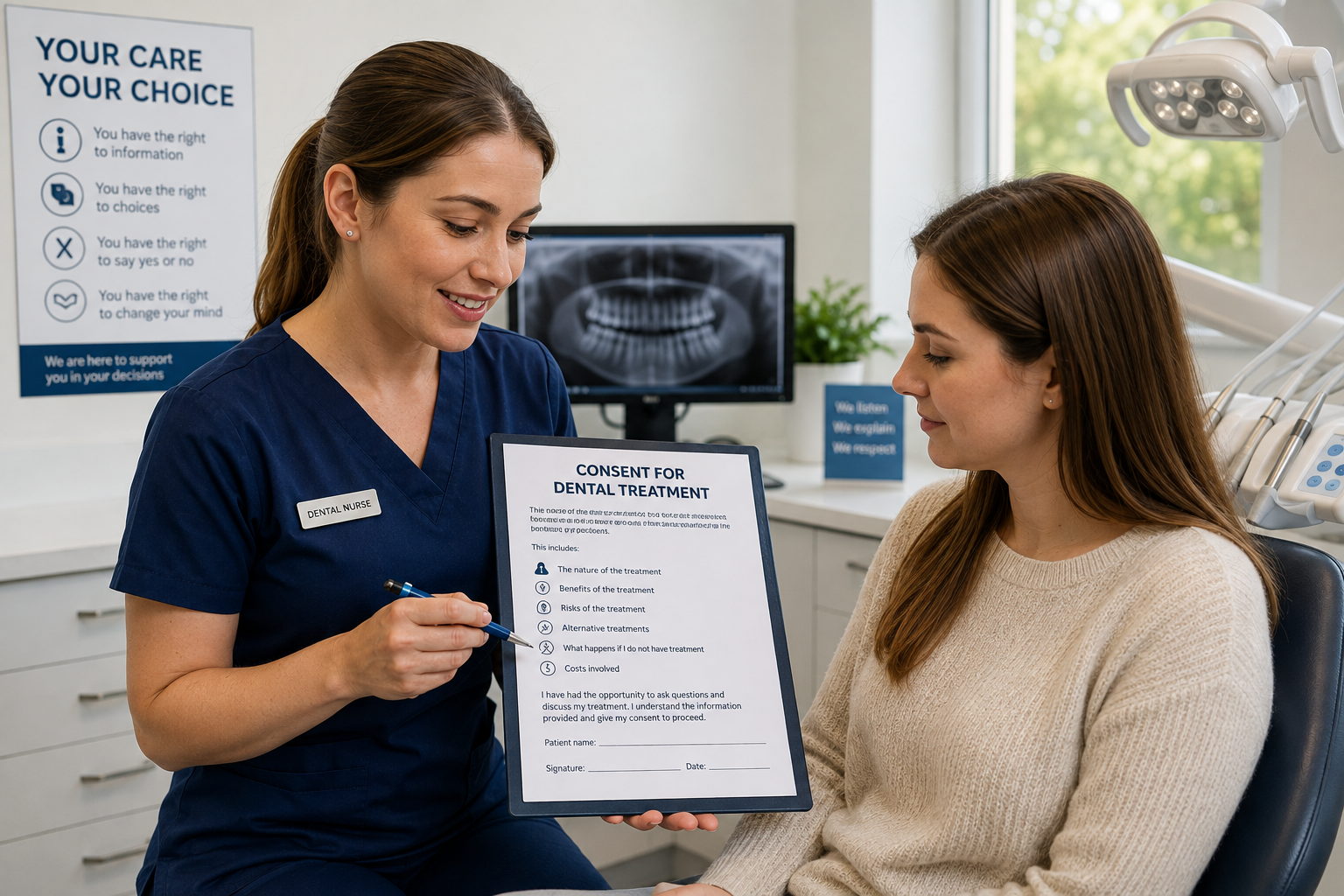
Consent is part of everyday dentistry.
From a routine examination to radiographs, restorative treatment, extractions and more complex procedures, patients have the right to understand what is being proposed and make decisions about their own care.
Yet consent is sometimes reduced to a form that needs signing before treatment begins.
That is a mistake.
A signature can provide evidence that consent was given, but valid consent is fundamentally a process of communication and decision-making. The GDC states that the discussions with the patient determine whether consent is valid, not simply the presence of a signature on a form.
For dental nurses, understanding this matters. You may not be the person leading a complex treatment discussion, but as a registered dental professional involved in patient care, you still have responsibilities around consent, communication and recognising when something does not appear right.
What Makes Consent Valid?
For consent to be valid, the patient needs to make a voluntary and informed decision and have the capacity to make that particular decision.
In practical terms, this means the patient should not simply be told:
“We’re doing a crown today. Sign here.”
They need appropriate information about the proposed care so they can make an informed choice.
Depending on the treatment, relevant information may include:
- What the proposed treatment involves.
- Why it is being recommended.
- Reasonable alternatives.
- Relevant risks and potential benefits.
- What may happen if treatment is not carried out.
- Expected outcomes or limitations.
- Costs where applicable.
The information also needs to be communicated in a way the patient can understand.
The GDC currently requires dental professionals to give patients sufficient information and reasonable time to consider it, taking their individual communication needs into account.
Why Consent Matters to Dental Nurses
It can be tempting to think:
“The dentist obtains consent. I’m the dental nurse, so this isn’t really my responsibility.”
The reality is more nuanced.
The treating clinician carries responsibility for ensuring valid consent for the treatment they provide, and the GDC’s February 2026 guidance confirms that obtaining consent may be delegated to an appropriately qualified individual who understands the patient’s history. However, the treating clinician remains responsible for ensuring valid consent has been given before treatment begins.
At the same time, GDC Standard 3.1.1 tells dental professionals involved in care not to simply assume that someone else has obtained the patient’s consent.
For a dental nurse, this does not mean independently explaining complex treatment risks or alternatives outside your knowledge and competence.
It means remaining professionally alert.
You may be the person who notices that:
- The patient seems confused about what is happening.
- The patient tells you they have changed their mind.
- The patient believes they are having a different procedure.
- A patient asks a clinical question you cannot appropriately answer.
- Treatment appears to have changed from what the patient expected.
- The patient looks reluctant or uncomfortable about proceeding.
In these situations, your role may simply be to recognise the concern and ensure the appropriate clinician addresses it.
That is part of being an effective member of the dental team.
Our Understanding Your Scope of Practice as a Dental Nurse guide explains why recognising when something needs to be referred to another professional is itself an important part of professional judgement.
Never Simply Assume Consent Has Been Dealt With
Imagine a patient arrives for a surgical extraction.
The consent form is in the notes and has been signed.
While preparing the patient, they say:
“I’m still not sure why this tooth needs to come out. I thought they were going to try to save it.”
The existence of a signed form does not mean you should ignore that statement.
The appropriate response is to make sure the treating clinician is aware and that the patient’s questions are addressed before proceeding.
Similarly, if a patient tells you privately:
“I don’t really want this treatment, but my partner thinks I should have it.”
that information matters.
Consent must be voluntary.
A patient sitting in the dental chair does not remove their right to question, delay or refuse treatment.
The GDC’s current consent guidance emphasises patients’ rights to participate in decisions about their health and the importance of ensuring they have made an informed choice.
Consent Continues Throughout Treatment
Another common misconception is that consent happens once.
Patient signs form.
Treatment begins.
Consent completed.
In reality, consent is ongoing.
The GDC describes giving and obtaining consent as a process rather than a one-off event and requires consent to remain valid at each stage of investigation or treatment.
This becomes particularly important when circumstances change.
Imagine a patient agrees to one treatment plan, but during treatment the clinician discovers something that requires a significant change.
The patient should be appropriately informed and consent obtained for the change rather than assuming the original consent covers everything that follows.
For an ongoing course of treatment, the GDC also requires specific consent for what is going to happen at that appointment.
What If the Patient Says Stop?
Patients can change their minds.
Consent given five minutes ago does not remove someone’s right to withdraw it.
If a patient indicates that they want treatment to stop, that communication must be taken seriously.
The GDC confirms that patients have the right to withdraw consent, refuse treatment or ask for treatment to stop after it has started.
A patient may communicate this verbally, but dental nurses should also remain alert to situations where a patient appears distressed or is attempting to communicate difficulty during treatment.
The clinical circumstances will determine how treatment can safely be paused or stopped, particularly during an active procedure, but the patient’s wishes cannot simply be disregarded.
If you become aware that the patient wants treatment to stop, communicate this to the clinician immediately.
What If the Patient Seems Confused?
Consider another situation.
A patient arrives expecting:
“Just a filling.”
During the appointment, they realise the planned procedure is more extensive and say:
“Nobody told me this was what I was having today.”
That should not be dismissed as an inconvenience.
Confusion may indicate that further discussion is needed before treatment continues.
You do not need to provide an explanation beyond your competence. Instead, make sure the clinician knows that the patient has questions or appears not to understand the proposed care.
This is where good communication becomes central to consent.
Our GDC Standards for the Dental Team Explained for Dental Nurses explores the wider professional responsibilities around patient communication and putting patients’ interests first.
Consent and Mental Capacity
Capacity is an important part of valid consent, but it is also an area where dental professionals need to avoid assumptions.
A diagnosis, disability, communication difficulty or someone’s appearance does not automatically mean that they lack capacity.
Capacity relates to the person’s ability to make the particular decision in question.
The GDC requires dental professionals to consider whether patients are able to make decisions about their own care and specifically warns against making assumptions about someone’s ability to give consent.
In England and Wales, the Mental Capacity Act provides the legal framework for decisions involving adults who may lack capacity.
Complex capacity decisions should be managed according to the relevant legislation and professional guidance. A dental nurse should not independently decide that a patient “cannot consent” simply because communication is difficult.
Sometimes the first step is improving communication.
Communication Needs Do Not Automatically Mean Lack of Capacity
A patient may have difficulty understanding information because:
- English is not their first language.
- They have hearing or visual impairment.
- They have a learning disability.
- They are extremely anxious.
- Information has been explained too quickly.
- The language being used is unnecessarily technical.
Those circumstances may require additional communication support rather than an assumption that the patient cannot make their own decision.
The GDC expects information to be tailored to individual patient needs and recommends appropriate support for patients with communication difficulties.
The objective is not merely to provide information.
It is to help the patient understand the decision they are being asked to make.
What About Children and Young People?
Consent involving children and young people can be more complex.
Depending on their age and circumstances, consent may involve someone with parental responsibility or the young person themselves where they have the legal ability and sufficient understanding to make the relevant decision.
This is an area where dental nurses should avoid relying on simplified rules such as:
“They’re under 16, so the parent always decides.”
The legal position can depend on age, competence, the proposed treatment and the circumstances.
Where there is uncertainty, the appropriate clinician should assess the situation and follow current legal and professional guidance.
For the dental nurse, the practical principle remains the same: do not make assumptions, and raise uncertainty with the appropriate professional.
What Should Be Recorded About Consent?
Good consent and good record keeping are closely connected.
The GDC expects discussions involved in obtaining and confirming consent to be documented.
Records may need to demonstrate matters such as:
- The treatment options discussed.
- Relevant risks and benefits.
- Costs.
- Questions raised by the patient.
- Information provided.
- Changes to the proposed treatment.
- Confirmation of ongoing consent.
The GDC’s February 2026 consent guidance goes further in emphasising that documentation should reflect the patient’s understanding of their options and confirm that an informed choice was made.
Again, this shows why a signed consent form should not be treated as the entire consent record.
When Should a Dental Nurse Speak Up?
There are situations where saying nothing may not be appropriate.
You should consider alerting the appropriate clinician if, for example:
- The patient says they do not want treatment.
- The patient asks for treatment to stop.
- They appear unaware of what treatment is planned.
- They believe they are receiving a different procedure.
- They appear confused about important information.
- They ask you a clinical question outside your competence.
- You hear information that may materially affect their decision.
- The proposed treatment appears to have changed and the patient seems unaware.
Usually, you do not need to solve the consent issue yourself.
The immediate professional response can be much simpler:
Stop, clarify and involve the appropriate clinician.
If something has already gone wrong because valid consent may not have been obtained, the principles discussed in When You Make a Mistake at Work: A Professional Guide for Dental Nurses may also become relevant.
Consent Is Part of Patient-Centred Care
Consent should not be viewed as administrative protection for the dental practice.
Its purpose is much more fundamental.
Patients have the right to make informed decisions about what happens to them.
For dental nurses, supporting that principle means listening carefully, communicating appropriately, recognising uncertainty and knowing when something needs to be brought to the clinician’s attention.
You do not need to become the person who independently explains every clinical risk or treatment alternative.
You do need to understand that consent is relevant to everyone involved in patient care.
The most useful question is therefore not:
“Has the form been signed?”
It is:
“Does this patient understand what is happening and are they willing to proceed?”
That distinction is at the heart of valid consent in dental practice.
Frequently Asked Questions
What is valid consent in dental practice?
Valid consent requires the patient to make a voluntary and informed decision and to have the capacity to make that particular decision. They should receive appropriate information about the proposed treatment and relevant options, risks, benefits and costs.
Is a signed consent form enough for dental treatment?
No. The GDC states that while a signature can help verify consent, the discussions with the patient determine whether consent is valid. Relevant discussions should also be appropriately documented.
What should a dental nurse do if a patient withdraws consent?
Make sure the clinician is informed immediately. Patients have the right to withdraw consent or ask for treatment to stop, including after treatment has started.
Can a dental nurse obtain consent?
Consent can be delegated to an appropriately qualified individual who understands the patient’s history, according to the GDC’s February 2026 guidance. However, the treating clinician remains responsible for ensuring valid consent has been given before treatment begins. A dental nurse must also remain within their own competence and scope when involved in the consent process.
What happens if a patient does not have capacity to consent?
The appropriate legal framework and professional guidance must be followed. Capacity should not be assumed or dismissed casually, and it relates to the particular decision being made. Complex situations should be managed by the appropriate clinician with reference to applicable legislation and guidance.
Does consent need to be checked throughout dental treatment?
Yes. The GDC requires consent to remain valid at every stage of investigation or treatment and describes consent as an ongoing process rather than a one-off event.
Can a patient change their mind after signing a consent form?
Yes. Signing a form does not prevent a patient from later changing their mind, refusing treatment or withdrawing consent.
Discover more from Dental Nurse Hub | Learn, Practice & Grow
Subscribe to get the latest posts sent to your email.