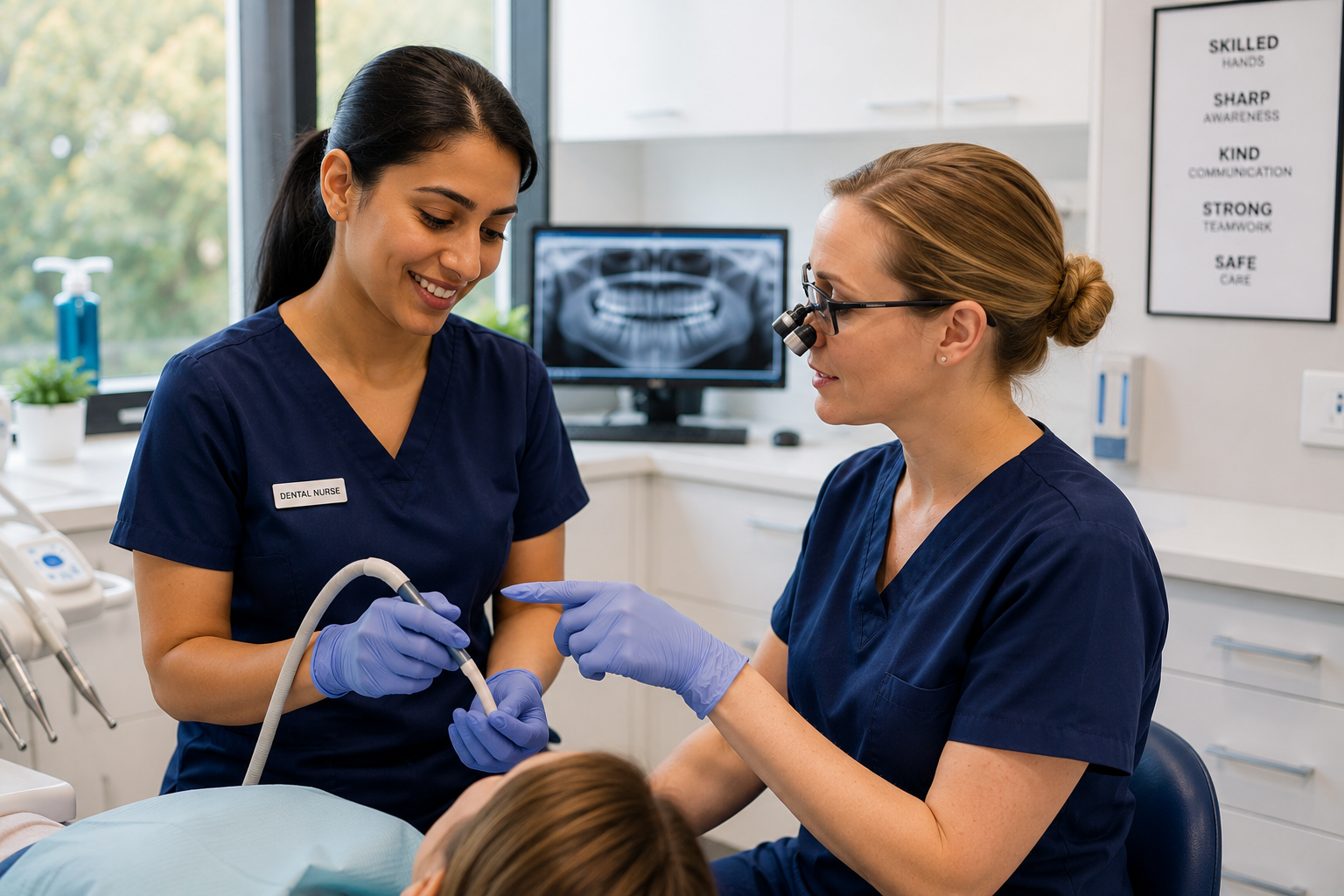
Most dental nurses have worked alongside someone who seems to make chairside nursing look effortless.
The surgery is prepared properly. They know where everything is. They anticipate what may be needed next, notice when something is not right and communicate calmly with both the clinician and patient.
It can look like natural ability.
Usually, it is not.
These qualities develop through experience, reflection and a collection of professional skills that go far beyond passing instruments quickly.
Being a dental nurse clinicians trust is not about agreeing with everything they say or trying to prove that you can handle every situation independently. It is about becoming reliable, observant, communicative and capable of using appropriate professional judgement.
For newly qualified dental nurses in particular, these qualities take time to develop.
Reliability Comes Before Speed
Speed is often mistaken for competence in dental nursing.
When you are newly qualified, watching an experienced nurse prepare a surgery in minutes or anticipate an entire procedure can make you feel slow.
But speed should not be your first objective.
Reliability matters more.
A reliable dental nurse:
- Prepares appropriately for the day’s treatments.
- Checks that necessary materials and equipment are available.
- Follows infection prevention procedures consistently.
- Communicates problems before they become bigger problems.
- Completes tasks they have agreed to undertake.
- Maintains standards even when the practice becomes busy.
- Can be trusted to say when they are unsure.
Speed usually develops naturally through repetition.
Rushing before you have developed a reliable routine can create mistakes.
If you are still adjusting to the responsibilities that come with registration, From Student to Registered Professional: What Changes When You Qualify as a Dental Nurse? explores that transition in more detail.
Learn to Think Ahead, Not Just Follow Instructions
Early in training, dental nursing can feel like remembering sequences.
Etch. Wash. Bond. Cure.
Instrument. Material. Suction.
With experience, something important begins to change.
You stop simply remembering what comes next and start understanding why it comes next.
That understanding allows you to anticipate more effectively.
During a routine restorative procedure, for example, you may begin recognising which stage of treatment the clinician has reached and preparing what is likely to be needed next.
The same principle applies across dentistry.
The more you understand the procedure, materials and possible variations, the easier it becomes to provide effective chairside support.
Anticipation should not become guessing, however.
If you are uncertain about what a clinician intends to do, ask.
Good dental nursing involves thinking ahead while remaining clear about what you know and what you do not know.
Develop Situational Awareness in the Surgery
A strong dental nurse is not focused exclusively on the dentist’s hands.
There is much more happening in the surgery.
You may need to notice:
- How the patient is responding.
- Whether suction is effective.
- Whether materials are ready.
- Whether equipment is functioning correctly.
- Whether infection prevention standards are being maintained.
- Whether the patient appears increasingly anxious or uncomfortable.
- Whether something needed later in the procedure is missing.
This is situational awareness.
Consider a patient who becomes unusually quiet, changes colour or begins behaving differently during treatment.
A nurse concentrating only on instruments may miss those changes.
An observant nurse may recognise them early and alert the clinician.
This ability develops through experience because routine tasks gradually require less conscious attention, allowing you to take in more of what is happening around you.
Communication Is One of Your Most Important Professional Skills
Technical ability alone does not make someone an effective dental nurse.
Communication affects almost everything you do.
You communicate with clinicians about treatment.
You reassure patients.
You pass information between team members.
You may need to explain that equipment is unavailable, alert someone to a medical history concern or clarify an instruction you do not understand.
Effective communication is not about talking constantly. It is about communicating the right information, clearly, at the right time.
The GDC’s current Standards require dental professionals to work effectively with colleagues, contribute to good teamwork and communicate clearly with other team members in patients’ interests.
That means communication is not simply a useful personality trait. It forms part of professional practice.
Our GDC Standards for the Dental Team Explained for Dental Nurses looks more closely at how these expectations apply to everyday dental nursing.
Show Initiative Without Overstepping Your Role
Initiative is one of the qualities clinicians often value most in an experienced dental nurse.
But there is an important difference between initiative and overstepping.
Good initiative might look like:
“We’re running low on this material and there is an implant case tomorrow, so I’ve checked whether we have enough stock.”
Or:
“The scanner wasn’t connecting properly this morning, so I’ve reported it before this afternoon’s appointment.”
That is very different from carrying out an unfamiliar task because you want to demonstrate that you are capable.
The GDC’s current Scope of Practice guidance makes clear that dental professionals should only carry out tasks or make decisions about patient care when they have the necessary skills and are appropriately trained, competent and indemnified.
Your personal scope can develop as you gain further training and experience, but professional judgement includes recognising your limits.
If you are unsure where those boundaries lie, read Understanding Your Scope of Practice as a Dental Nurse.
The best initiative makes the team safer and more efficient. It does not place the patient or the dental nurse at unnecessary risk.
Learn How Different Clinicians Work Without Compromising Standards
Working with different dentists is one of the fastest ways to develop adaptability.
One clinician may want their instruments arranged in a particular order. Another may use different restorative materials. A third may have a completely different workflow.
Learning these preferences makes chairside nursing smoother.
Over time, you begin remembering individual routines and anticipating what each clinician is likely to need.
However, adaptability has limits.
A clinician’s preference does not override professional standards, patient safety or your own competence.
If you are asked to do something you believe is unsafe or outside your competence, the appropriate response is not:
“That’s how this dentist likes it.”
It is to seek clarification and, where necessary, raise the concern appropriately.
Professional trust should work both ways.
A clinician should be able to trust your judgement, and you should be able to work in an environment where legitimate professional concerns can be raised.
What Trusted Dental Nurses Do When They Don’t Know
Trying to appear knowledgeable can sometimes have the opposite effect.
Imagine you have moved to a new practice and are asked to prepare equipment you have never used.
You have two options.
You could pretend you know what you are doing and hope you work it out.
Or you could say:
“I haven’t used this system before. Can you show me how it is set up here?”
The second response demonstrates better professional judgement.
The current GDC Standards require dental professionals to work within their knowledge, skills, professional competence and abilities. The GDC also states that a professional should only carry out a task when appropriately trained, competent, confident and indemnified.
Nobody works in dentistry long enough to encounter every material, technique or piece of equipment.
Knowing when you need help is part of competence.
How Professional Trust Develops Over Time
Trust rarely develops because of one impressive clinical session.
It develops through repeated behaviour.
Colleagues learn that:
- When you say you will do something, you do it.
- When you do not know something, you say so.
- When something goes wrong, you are honest.
- When you notice a problem, you communicate it.
- When you receive constructive feedback, you learn from it.
- When the practice becomes busy, your standards do not disappear.
- When patient safety is involved, you take it seriously.
How you respond when something goes wrong can be particularly important. When You Make a Mistake at Work: A Professional Guide for Dental Nurses explains why honesty, appropriate reporting and learning from incidents are central to professional practice.
Trust is therefore not the same as being the clinician’s favourite nurse.
It is confidence in your professional behaviour.
Confidence Is Not the Same as Competence
This distinction matters, particularly early in your career.
Someone can appear extremely confident while lacking the knowledge or experience needed for a particular task.
Another person may appear cautious while being highly competent.
Confidence is valuable, but it should develop alongside competence.
You do not need to pretend you are comfortable with something you have never done.
As your experience grows, procedures that once required intense concentration become familiar. Your preparation improves. You recognise patterns. You communicate more naturally. You start noticing problems earlier.
That is confidence built on experience.
If you are in your first year and feel that your progress is slower than other people’s, Starting Strong: Your First Year as a Newly Qualified Dental Nurse may help put that development into perspective.
Becoming the Nurse People Want to Work With
You do not need to be the fastest dental nurse in the practice.
You do not need to know every procedure.
You do not need to say yes to everything you are asked to do.
Instead, aim to become someone who is:
Reliable.
Prepared.
Observant.
Communicative.
Willing to learn.
Aware of their limitations.
Able to think ahead.
Focused on the patient.
Those qualities develop gradually.
Clinical experience matters, but so do the professional skills that determine how you use that experience. Clinical Skill Versus Professional Skill in Dental Nursing explores this distinction further and why both are important to becoming a well-rounded dental professional.
The dental nurse clinicians genuinely trust is rarely the person trying hardest to look impressive.
It is the person who consistently demonstrates that they can be relied upon to think, communicate, learn and act professionally.
Frequently Asked Questions
What makes a good dental nurse?
A good dental nurse combines clinical competence with reliability, communication, organisation, situational awareness and professional judgement. Patient safety and professionalism should remain central regardless of experience.
How can I become more confident as a dental nurse?
Confidence develops through repeated experience, appropriate training, feedback and reflection. Focus first on becoming safe and reliable rather than trying to become fast.
How can a dental nurse show initiative?
Initiative can include anticipating appropriate clinical needs, identifying potential problems, preparing effectively and communicating issues early. It should never involve carrying out tasks beyond your competence or professional scope.
How can I improve my chairside dental nursing skills?
Learn the purpose and sequence of the procedures you assist with rather than simply memorising instruments. Observe experienced colleagues, ask questions, seek feedback and reflect on areas where you need further development.
What should I do if I don’t know how to assist with a procedure?
Tell the clinician or appropriate colleague that the procedure or equipment is unfamiliar and ask for guidance. Do not pretend to be competent in something you have not been appropriately trained or prepared to undertake.
Should dental nurses learn each dentist’s working preferences?
Yes. Understanding individual workflows can improve teamwork and efficiency. However, a clinician’s preference should never override patient safety, professional standards or the limits of your own competence.
Discover more from Dental Nurse Hub | Learn, Practice & Grow
Subscribe to get the latest posts sent to your email.