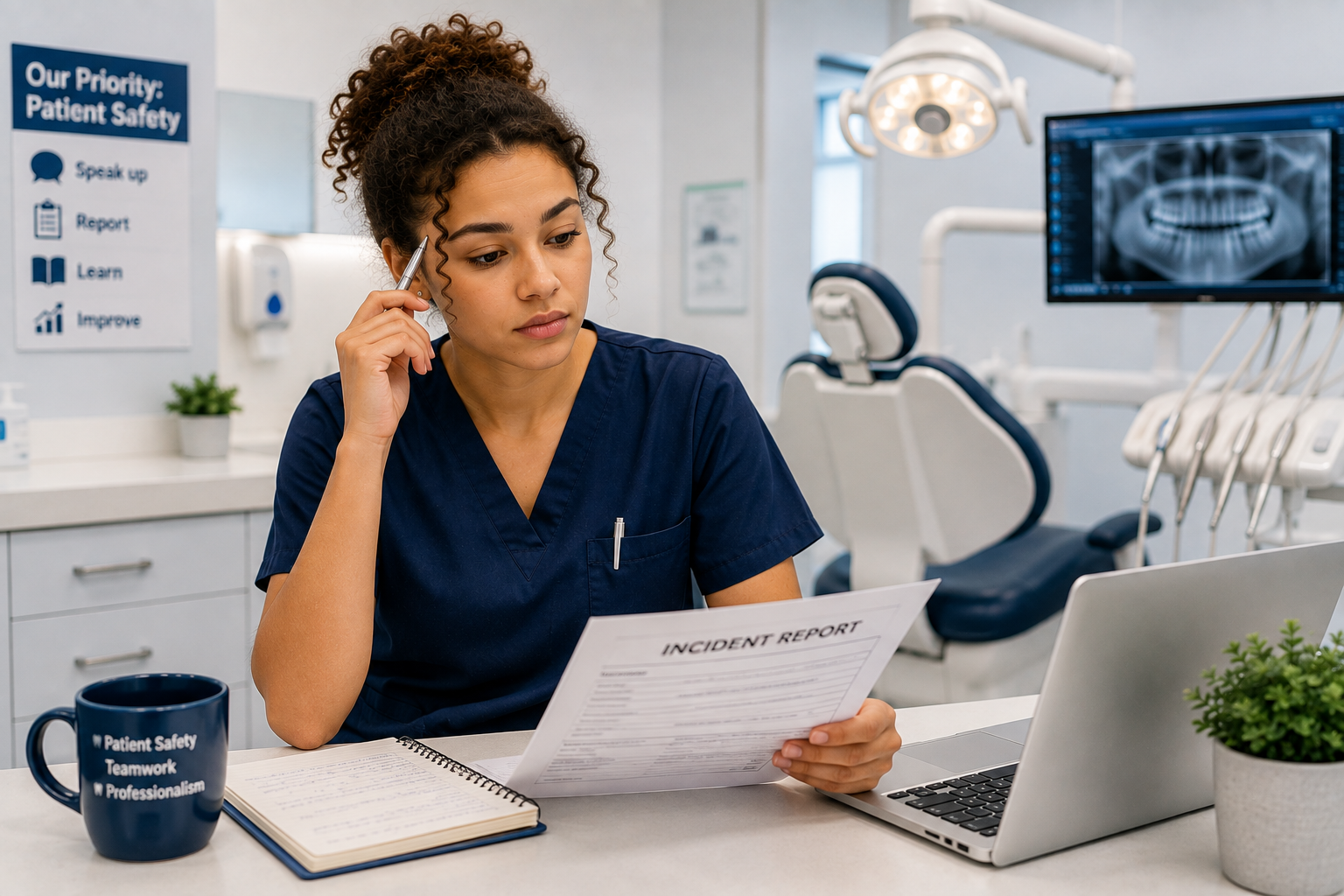
Mistakes can happen in dental practice.
Even careful and experienced professionals work in busy environments involving patients, instruments, medicines, equipment, clinical records and multiple stages of treatment. Human error cannot always be eliminated completely.
For a dental nurse, particularly someone early in their career, realising that you have made a mistake can be frightening.
You may immediately wonder whether the dentist will be angry, whether the patient has been harmed, whether you could lose your job or whether the incident could affect your professional registration.
Those concerns are understandable, but they should not determine what happens next.
The immediate priorities are patient safety, honesty and appropriate action.
A mistake should never be hidden simply because you are frightened of the consequences.
If you are still developing confidence after registration, From Student to Registered Professional: What Changes When You Qualify as a Dental Nurse? explains how accountability changes when you become a registered professional.
What Counts as a Mistake or Incident in Dental Practice?
When people hear the words “clinical incident”, they often imagine a serious medical emergency or major treatment error.
In reality, patient safety incidents can take many forms.
Examples might include:
- Incorrect information being entered into a patient’s record.
- An instrument being prepared incorrectly.
- A decontamination step being missed.
- The wrong material being prepared for treatment.
- Important information from a patient’s medical history not being communicated.
- Equipment being used incorrectly.
- Confidential information being sent to the wrong person.
- A medication-related error.
- A patient identification check being missed.
- A procedural error occurring during treatment.
These situations vary enormously in seriousness.
The fact that something went wrong does not mean every event requires exactly the same response. What happens next will depend on the circumstances, the actual or potential harm involved and the practice’s procedures.
Mistake, Incident and Near Miss: What Is the Difference?
These terms are sometimes used interchangeably in everyday conversation, but understanding the concepts can help dental nurses think more clearly about patient safety.
Mistake
A mistake occurs when something is done incorrectly or something that should have happened is missed.
Patient Safety Incident
An incident is an event or circumstance connected with care that resulted in harm or had the potential to result in harm.
Near Miss
A near miss is an event where something could have gone wrong, but harm was avoided because the problem was identified before it reached the patient or caused harm.
Imagine that the wrong local anaesthetic cartridge is selected during surgery preparation but the error is identified before it is used.
The patient has not been harmed, but the event may still reveal something important.
Perhaps two products have almost identical packaging. Perhaps they are stored beside each other. Perhaps the surgery layout makes selection errors more likely.
Near misses therefore provide valuable opportunities to identify weaknesses before an actual patient safety incident occurs.
First Priority: Protect the Patient
When something goes wrong, your first concern should be whether the patient is safe.
The exact response will depend on what has happened, but it may involve:
- Stopping an activity if continuing could create additional risk.
- Making the immediate situation safe where possible.
- Informing the appropriate clinician or senior team member promptly.
- Ensuring the patient receives any necessary assessment or care.
- Following the practice’s incident reporting and escalation procedures.
Do not quietly attempt to correct something if doing so could conceal an incident that another professional needs to know about.
Sometimes the appropriate action is straightforward. At other times, clinical judgement from the dentist or another appropriately qualified professional may be required.
Your responsibility is not necessarily to solve the entire situation yourself.
It is to recognise the problem and respond appropriately.
Tell Someone, Even When It Feels Uncomfortable
Fear can become one of the greatest risks after a mistake.
You might think:
“Can I fix this before anyone notices?”
“Maybe nothing will happen.”
“I don’t want the dentist to think I’m incompetent.”
“What if I lose my job?”
Those thoughts can be particularly powerful for newly qualified dental nurses who are still building professional confidence.
However, delaying or concealing important information can create additional risk.
If something has happened that may affect a patient, inform the appropriate person promptly.
The GDC expects registered dental professionals to put patients’ interests first and raise concerns when patients may be at risk.
Our GDC Standards for the Dental Team Explained for Dental Nurses provides a broader explanation of the professional standards that apply to registered dental nurses.
Being honest when something goes wrong is part of professional practice.
Do Not Alter Records to Hide What Happened
Clinical records must provide an accurate account of patient care.
If you realise that you have entered something incorrectly, follow the appropriate procedure for correcting or amending the record.
Never attempt to hide an error by:
- Falsifying information.
- Backdating an entry.
- Deleting information simply to conceal what occurred.
- Recording something you know did not happen.
- Asking another person to change records to protect you.
How an amendment should be made will depend on the record system and circumstances, but the integrity of the clinical record must be maintained.
Honesty is especially important when something has gone wrong.
Understand Incident Reporting
Dental practices should have systems for identifying, recording, reviewing and learning from incidents and near misses.
An incident report should not simply answer:
“Who made the mistake?”
A useful investigation asks broader questions:
- What happened?
- When did it happen?
- Was anyone harmed?
- What immediate action was taken?
- What factors contributed to the event?
- Could the same thing happen again?
- What could reduce the risk of recurrence?
Depending on the event, the practice response could include:
- Completing an incident report.
- Conducting a significant event review.
- Reviewing a risk assessment.
- Providing additional training.
- Changing a procedure.
- Improving communication systems.
- Reviewing equipment or storage arrangements.
- Monitoring whether corrective actions have worked.
This is clinical governance in practice.
It is one reason why genuine inspection readiness involves functioning systems rather than hurriedly preparing documents when an inspection is announced. Inspection Readiness Versus Inspection Panic explores that distinction in more detail.
Duty of Candour: What Dental Nurses Should Understand
Duty of candour is fundamentally about being open and honest when something goes wrong with patient care.
For individual dental professionals, the GDC describes a professional duty to be open and honest with patients when something goes wrong with their treatment or care.
There is also a statutory Duty of Candour under Regulation 20 for CQC-regulated providers.
These should not be confused.
The statutory process has specific requirements and includes a defined category called a “notifiable safety incident”. Not every error or undesirable outcome automatically meets that definition.
For dental nurses, the practical lesson is not that you personally need to decide whether every incident meets a legal threshold.
Instead:
- Report the incident promptly through the appropriate practice process.
- Provide an honest and factual account of what happened.
- Cooperate with any review or investigation.
- Do not conceal relevant information.
- Allow the appropriate clinician, registered provider or practice leadership to determine what further regulatory or patient communication processes are required.
Being open does not mean speculating about what happened or accepting responsibility for something before the facts are understood.
It means being truthful about what you know.
Saying Sorry Does Not Automatically Mean Admitting Liability
Healthcare professionals sometimes become nervous about apologising because they fear that saying sorry amounts to admitting legal liability.
The GDC’s professional duty of candour guidance specifically supports appropriate apologies when care has gone wrong.
An apology should be genuine and patient-centred.
However, the way an incident is communicated to a patient should be coordinated appropriately within the dental team. A dental nurse should not independently provide explanations about clinical causation or outcomes that fall outside their knowledge or role.
The important principle is openness, not speculation.
Why Did the Mistake Happen?
Once the immediate situation has been managed, the next question should not simply be:
“Who is responsible?”
It should also be:
“Why was this able to happen?”
Human error often occurs within a wider system.
Contributing factors might include:
- Fatigue.
- Interruptions.
- Poor communication.
- Time pressure.
- Inadequate training.
- Staff shortages.
- Unfamiliar equipment.
- Similar product packaging.
- Poor surgery layout.
- Unclear responsibilities.
- Inadequate procedures.
- Failure to communicate changes.
Consider a nurse who selects the wrong material because two almost identical packages are stored together.
The individual selection error matters.
But if several team members could easily make the same mistake, simply telling that nurse to “be more careful” does not remove the underlying risk.
A stronger response might involve changing how those materials are stored and labelled.
That is the difference between blame and meaningful improvement.
Reflect Without Destroying Your Confidence
Making a mistake can affect professional confidence, particularly early in your career.
You may replay the situation repeatedly and question whether you are good enough to do your job.
Reflection should not become self-punishment.
Useful reflection asks:
- What happened?
- What was I thinking at the time?
- Were there contributing factors?
- What did I learn?
- What would I do differently next time?
- Do I need further training?
- Does a practice system need improving?
The purpose is to develop insight and reduce future risk.
The GDC encourages reflective practice as part of professional development, including reflecting on things that do not go to plan.
Our Keeping Your GDC Registration: A Practical Guide to CPD Requirements explains how reflection and professional development fit into maintaining your knowledge and competence.
When the Mistake Was Not Entirely Yours
Dental care is delivered by teams.
Sometimes an incident cannot reasonably be attributed to one person.
There may have been:
- Unclear instructions.
- Miscommunication between colleagues.
- Equipment failure.
- An inadequate practice procedure.
- Several people involved at different stages.
- Information that was not available when a decision was made.
When reporting an incident, describe what happened objectively.
Do not automatically accept responsibility for things outside your control.
Equally, do not distort events to shift legitimate responsibility onto someone else.
A factual account is more useful than either self-blame or defensiveness.
What If Someone Asks You to Keep Quiet?
This can place a dental nurse in a very difficult position, especially when the person asking is more senior.
You might hear:
“Nothing happened, so don’t report it.”
“There’s no point writing that down.”
“We’ll just sort it ourselves.”
Seniority does not remove your professional responsibilities.
The GDC requires dental professionals to raise concerns when they believe patients may be at risk, including where someone asks them to do something that conflicts with their duty to protect patients.
Usually, concerns should first be raised through appropriate workplace channels.
However, situations vary. Serious concerns, unsuccessful local escalation or genuine fears of deliberate concealment may require further action.
This is an area we will explore separately in Speaking Up in Dental Practice: Raising Concerns Without Losing Professional Confidence.
Could Making a Mistake Affect Your GDC Registration?
This is understandably one of the biggest fears for registered dental nurses.
There is no useful answer that treats every mistake in the same way.
Context matters.
An isolated error that is recognised, reported appropriately and followed by reflection and improvement is very different from deliberate dishonesty, repeated unsafe behaviour or knowingly putting patients at risk.
Rather than immediately assuming the worst, focus on what you can control:
- Protect the patient.
- Be honest.
- Report appropriately.
- Cooperate with any investigation.
- Reflect on what happened.
- Complete additional learning if needed.
- Make changes that reduce the likelihood of recurrence.
Professionalism is demonstrated not only by what happens when everything goes well, but also by how you respond when something does not.
Turning an Error Into Improvement
A good patient safety culture does not ignore mistakes.
It learns from them.
Consider this example:
Problem: Two materials with similar packaging are stored beside each other.
Incident: The wrong material is selected during surgery preparation.
Immediate response: The error is identified and managed appropriately.
Review: The team discovers that the packaging and storage arrangement make selection errors more likely.
Action: The products are separated, storage is reorganised and the team is informed.
Follow-up: The new arrangement is reviewed to ensure it has reduced the risk.
The objective is not simply to identify who selected the wrong item.
The objective is to make the system safer for the next patient.
CQC describes clinical governance as encompassing quality assurance, quality improvement, risk management and incident management. Learning from incidents is therefore part of a wider system of continuously improving care.
A Simple Framework for Responding to a Mistake
When something goes wrong, the following STOP framework can help you remember the immediate principles.
S: Secure Patient Safety
Stop and consider whether the patient is currently at risk. Take appropriate immediate action within your competence.
T: Tell the Appropriate Person
Inform the relevant clinician, senior dental nurse, practice manager or other appropriate person promptly.
O: Objectively Record What Happened
Follow the practice’s incident reporting process and provide an accurate factual account.
P: Participate in Review and Prevention
Reflect on the incident, cooperate with the review and help identify changes that could prevent recurrence.
STOP is a memory aid, not a replacement for your practice’s incident procedure or professional guidance.
Different incidents require different responses.
Professionalism Is Tested Most When Something Goes Wrong
Being a good dental nurse does not mean never making a mistake.
Dental professionals are human, and healthcare systems are complex.
What matters enormously is what happens next.
Protect the patient.
Be honest.
Tell the appropriate person.
Record events accurately.
Reflect on what happened.
Learn from the incident.
Improve the system where possible.
If you are unsure whether something falls within your responsibilities, Understanding Your Scope of Practice as a Dental Nurse can help you distinguish professional accountability from being expected to manage situations outside your competence.
A mistake can be uncomfortable and sometimes serious. But when handled properly, incidents and near misses can also reveal weaknesses that would otherwise remain hidden.
A professional dental team does not build safety by pretending errors never happen.
It builds safety by recognising them, responding appropriately and learning from them.
Frequently Asked Questions
What should a dental nurse do after making a mistake?
Prioritise patient safety and inform the appropriate clinician or senior team member promptly. Follow the practice’s incident procedure, provide an accurate account of what happened and cooperate with any review or follow-up action.
Do dental nurses have to report clinical incidents?
Dental nurses have professional responsibilities relating to patient safety and raising concerns. Practices should also have procedures for reporting incidents and near misses. The exact reporting route will depend on the event and local procedures.
What is a near miss in dental practice?
A near miss is an event that could have resulted in harm but did not, often because the problem was identified before reaching the patient. Near misses are valuable opportunities to identify and reduce risks.
Can a dental nurse get in trouble for making a mistake?
The circumstances matter. An isolated error that is recognised and handled appropriately is not equivalent to deliberate dishonesty, repeated unsafe behaviour or concealing something that puts patients at risk. If you are involved in a serious incident or are concerned about your professional position, seek appropriate professional advice.
What should I do if someone asks me not to report an incident?
Do not allow pressure from another person to override your responsibility to patient safety. Follow the practice’s appropriate reporting or escalation procedure. If the concern cannot safely or effectively be addressed locally, further escalation may be necessary.
What is Duty of Candour in dental practice?
The professional duty of candour requires healthcare professionals to be open and honest with patients when something goes wrong with their care. CQC’s statutory Duty of Candour also places specific requirements on regulated providers when a notifiable safety incident occurs. The two are related but are not identical.
Should dental nurses reflect on mistakes?
Yes. Reflection can help identify what contributed to an incident, what was learned and what could be changed. Reflection should support improvement rather than become an exercise in self-blame.
Discover more from Dental Nurse Hub | Learn, Practice & Grow
Subscribe to get the latest posts sent to your email.