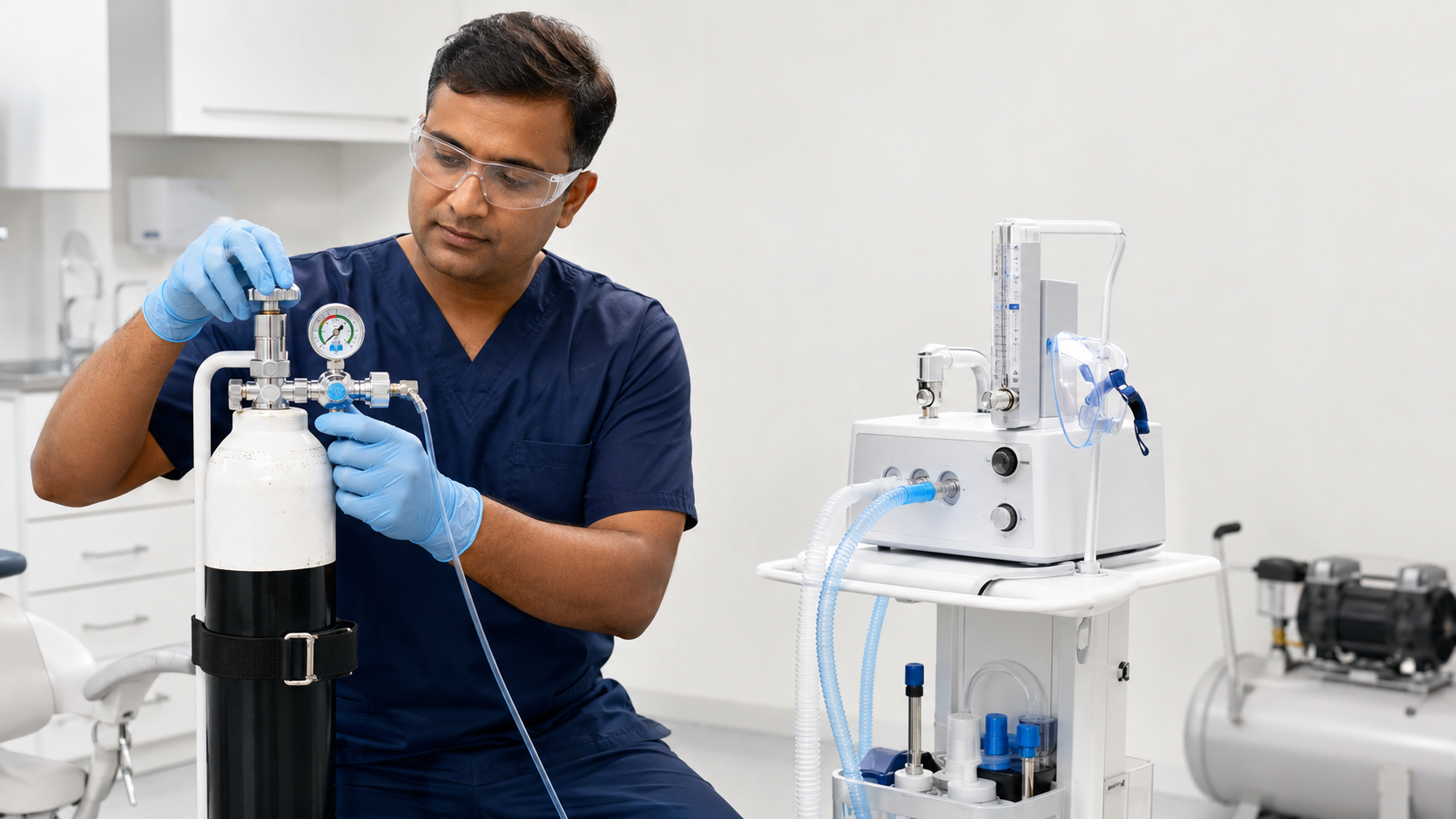
Oxygen cylinders, dental compressors and suction systems are so familiar that it is easy to stop seeing them as potential risks. They sit quietly in storage areas, plant rooms and surgeries, often working reliably for years.
But when something goes wrong, the consequences can be serious. An oxygen leak can increase the risk of fire, a faulty compressor can interrupt treatment, and ineffective suction can make it difficult to continue a procedure safely.
NHS England published a revised version of Health Technical Memorandum 02-01 in August 2026. Usually shortened to HTM 02-01, this guidance explains how medical gas pipeline systems should be designed, managed and maintained.
It also includes guidance relating to dental compressed-air and vacuum systems.
This does not mean every dental practice needs to introduce a complicated hospital-style management structure. The requirements depend on the systems installed. The important first step is understanding what equipment your practice has and which guidance applies to it.
What Systems Might a Dental Practice Use?
Dental practices may use gases, compressed air and suction for several different purposes.
Oxygen
Most practices keep an oxygen cylinder as part of their medical-emergency equipment. Oxygen may also be used during conscious sedation or supplied through fixed pipework in larger premises.
Nitrous oxide
Nitrous oxide is mixed with oxygen for inhalation sedation. Depending on the practice, it may be supplied through portable cylinders or a fixed pipeline system.
Dental compressed air
Compressed air powers handpieces and other dental equipment. It is usually produced by a compressor and delivered to the surgeries through pipework.
Vacuum and suction
Vacuum systems provide the suction used during treatment. Some practices use independent suction units, while others have a central system serving several surgeries.
These systems perform different jobs and should not all be managed in exactly the same way.
What Is HTM 02-01?
HTM 02-01 is NHS England guidance for medical gas pipeline systems in healthcare premises.
A medical gas pipeline system carries gas from a central supply through fixed pipes to outlets elsewhere in the building. For example, a practice might have oxygen or nitrous oxide outlets installed in a sedation room.
The revised guidance is divided into two parts:
- Part A covers how systems should be designed, installed and tested.
- Part B covers how they should be managed, maintained and used safely.
The guidance gives greater attention to staff competence, emergency planning, system failures, maintenance and clear responsibility.
Part A also includes provisions relating to dental compressed-air and vacuum systems. The complete documents are available through NHS England’s HTM 02-01 publication page.
Dental nurses do not need to understand every engineering detail in the document. However, they should understand the systems they use, recognise obvious problems and know when to stop and report a concern.
Does HTM 02-01 Apply to Your Practice?
The answer depends on what is installed.
A portable emergency oxygen cylinder is not a medical gas pipeline system. A fixed oxygen supply running through the building is.
Likewise, a small self-contained suction unit is different from a central vacuum system serving several surgeries.
The following table provides a useful starting point:
| Equipment or system | How HTM 02-01 may apply |
|---|---|
| Fixed oxygen or nitrous oxide pipeline | The guidance is directly relevant |
| Central medical vacuum system | The guidance is directly relevant |
| Installed dental compressed-air system | Relevant dental provisions should be considered |
| Portable emergency oxygen cylinder | Not a pipeline system, but other safety requirements still apply |
| Portable inhalation-sedation cylinders | Pipeline requirements may not apply, but safe storage, use and maintenance remain essential |
| Self-contained compressor or suction unit | Manufacturer instructions and other equipment or pressure-system requirements may apply |
If the practice is uncertain, it should ask a competent service engineer or specialist adviser to confirm the type of system.
Do not assume that equipment is outside the guidance simply because it has always been in the practice or has never caused a problem.
Portable Cylinders Versus Fixed Systems
Understanding this distinction makes the rest of the subject much easier.
A portable oxygen cylinder can be moved to wherever it is needed. It usually has a regulator attached and is stored with the practice’s emergency equipment.
A fixed pipeline carries gas through permanent pipework, often hidden inside the walls or ceiling. Staff use the gas through an outlet in the treatment room.
Fixed systems need specialist design, testing and ongoing management because a fault in one part of the installation may affect several rooms or services.
Portable cylinders do not require the same pipeline arrangements, but they still need to be managed safely.
The practice should consider:
- Where cylinders are stored
- Whether they are protected from falling or being damaged
- Whether they are exposed to heat
- Who checks their contents and expiry
- Whether the regulator and tubing are in good condition
- How staff move and connect them
- What staff should do if a leak is suspected
- Whether employees know how to use the equipment
Oxygen does not burn by itself, but it helps other materials burn much more fiercely. Even a small leak can create an oxygen-enriched environment where clothing, bedding or other materials ignite more easily.
The Health and Safety Executive advises workplaces using oxygen cylinders to prevent leaks, maintain oxygen equipment and control fire and explosion risks. HSE guidance on oxygen use in the workplace
Keeping Emergency Oxygen Ready
Having an oxygen cylinder in the practice does not automatically mean the team is prepared for an emergency.
The cylinder may be present, but:
- It could contain too little oxygen.
- The regulator might be damaged.
- The tubing or mask might be missing.
- Staff may not know how to operate it.
- Equipment may be difficult to reach quickly.
- The cylinder may have missed its servicing schedule.
Routine checks should confirm that the oxygen equipment is available, complete, accessible and ready to use.
Dental nurses are often closely involved in these checks. They may monitor cylinder contents, check masks and tubing, record expiry dates and report damaged equipment.
They should also know what to do if the cylinder has been used, appears faulty or cannot be operated safely.
For wider emergency preparation, see the Medical Emergencies Study Guide for Dental Nurses.
Using Nitrous Oxide Safely
Nitrous oxide and oxygen can provide effective inhalation sedation for anxious patients. However, safe use depends on more than having the correct cylinders.
The practice must also consider:
- Suitable sedation equipment
- Correct connections
- Effective ventilation
- A functioning scavenging system
- Pre-use equipment checks
- Planned servicing
- Staff training
- Patient monitoring
- Emergency arrangements
Scavenging removes waste gas breathed out by the patient. If the system is ineffective, or the nasal mask does not fit properly, nitrous oxide may escape into the surgery.
Repeated avoidable exposure is a workplace safety concern for the dental team. A familiar smell or occasional headache should not be dismissed as an unavoidable part of sedation work.
Staff should report suspected leaks, poor-fitting equipment, ineffective scavenging or unusual equipment behaviour.
Dental nurses assisting with conscious sedation must have suitable training and work within their competence. This article provides safety awareness and does not replace clinical sedation training.
For related learning, visit the Pain and Anxiety Control Study Guide.
Why Dental Compressed Air Matters
The compressor is easy to forget because it is often hidden in a plant room or cupboard. Yet it supplies the air used by equipment throughout the practice.
A compressed-air system may include:
- The compressor
- An air receiver
- Filters
- A dryer
- Pressure controls
- Pipework leading to the surgeries
Problems with moisture, filtration, pressure or maintenance can affect the quality and reliability of the air supply.
Warning signs may include:
- Unusual noises
- Excessive vibration
- Repeated pressure loss
- Water or moisture in the system
- Overheating
- Frequent breakdowns
- Poor handpiece performance
- Service dates being missed
Dental nurses are not expected to diagnose compressor faults. Their responsibility is to recognise when something appears abnormal, stop using affected equipment where necessary and report the problem.
Some compressed-air systems are covered by the Pressure Systems Safety Regulations 2000. Where these regulations apply, the system may require a written scheme of examination and periodic examination by a competent person.
This is different from routine servicing. A service keeps equipment working, while a formal examination considers whether the relevant pressure system remains safe.
The HSE explains that qualifying pressure equipment must have an appropriate written scheme and be examined in accordance with it. HSE guidance on pressure systems
The practice should obtain competent advice to establish whether its particular compressor and air receiver are covered.
Do Not Forget the Suction System
Suction systems remove saliva, fluids, debris and aerosols during treatment. If suction fails, some procedures may not be able to continue safely.
A central system may serve several surgeries. A single fault could therefore affect much of the practice.
The practice should have clear arrangements for:
- Routine cleaning
- Filter and trap management
- Planned servicing
- Amalgam separation where applicable
- Safe handling of contaminated parts
- Reporting reduced performance
- Responding to complete failure
- Contacting the service contractor
Dental nurses may complete routine cleaning and user maintenance where this falls within their training and the manufacturer’s instructions.
They should not open, repair or modify parts of the system that require an engineer. Vacuum equipment can contain contaminated material as well as mechanical and electrical hazards.
If suction becomes weak or stops during treatment, staff should know whether the procedure can continue, what alternative equipment is available and who must be contacted.
What Should Dental Nurses Check?
The exact checks will depend on the practice and equipment. However, dental nurses may be asked to confirm that:
- Emergency oxygen is available and accessible
- The cylinder contains sufficient oxygen
- Masks, tubing and other accessories are present
- Equipment appears undamaged
- Required service dates have not passed
- Sedation equipment passes the approved pre-use checks
- Suction is functioning normally
- Compressor or vacuum alarms are not showing a fault
- Problems have been recorded and reported
- Equipment labelled as unsafe is not used
These checks should follow an agreed procedure rather than personal habit.
A dental nurse should never feel pressured to repair, adjust or reconnect unfamiliar equipment simply because a patient is waiting. If the equipment cannot be confirmed as safe, the correct response is to stop and escalate.
This reflects the wider principles discussed in Understanding Your Scope of Practice as a Dental Nurse.
Training Must Match the Responsibility
Staff training should reflect what the person is actually expected to do.
Someone who only checks the emergency oxygen cylinder needs different training from an employee who changes cylinders on a sedation system or responds to pipeline alarms.
Relevant training may include:
- Basic gas-safety awareness
- Oxygen fire risks
- Cylinder storage and handling
- Pre-use equipment checks
- Recognising leaks
- Responding to alarms
- Emergency isolation procedures
- Reporting faults
- Using reserve equipment
Signing a policy or attending a presentation does not automatically prove competence.
Where a task involves practical skills, the employee should be able to demonstrate that they can perform it safely. The practice can record this through a competency assessment, supervised demonstration or other suitable evidence.
Staff should also know their limits. Recognising that a problem requires specialist help is an important part of competence.
Servicing Is Only Part of the Safety System
Practices often rely heavily on service stickers. These are useful, but they do not answer every safety question.
A complete system should establish:
- What equipment requires servicing
- How frequently it should be serviced
- Whether formal examination is also required
- Who is competent to complete the work
- What staff should check between service visits
- How defects are recorded
- Who confirms equipment can return to use
- What happens when servicing is overdue
Maintenance frequencies should be based on manufacturer instructions, applicable guidance, the system risk assessment and specialist advice.
A service report should be reviewed rather than simply filed. If the engineer identifies a defect or recommends further action, someone must make sure that action is completed.
What Happens If the System Fails?
Equipment failure should be planned for before it happens.
Possible problems include:
- An empty or leaking oxygen cylinder
- Nitrous oxide escaping into the surgery
- Compressor failure
- Loss of suction
- A pipeline alarm
- Damage to an outlet
- A power cut
- Failure during sedation or another procedure
The response plan should answer practical questions:
- Must treatment stop?
- How will the patient be kept safe?
- Is reserve equipment available?
- Who can isolate the system?
- Which contractor should be contacted?
- Can another surgery be used?
- How will the incident be recorded?
- Who confirms that the equipment is safe to use again?
These arrangements should form part of the practice’s wider emergency and business-continuity planning.
A contact number kept in an old folder is not enough. Staff need to know where the information is and be able to access it quickly.
Common Mistakes to Avoid
Assuming HTM 02-01 only applies to hospitals
Relevant parts can apply to dental practices with fixed medical gas, compressed-air or central vacuum systems.
Treating every oxygen cylinder as a pipeline system
Portable cylinders still require controls, but they are not the same as fixed gas pipework.
Confusing servicing with formal examination
Routine maintenance and a statutory pressure-system examination serve different purposes.
Giving specialist roles to unqualified staff
A dental nurse or practice manager should not be given an engineering title simply because they complete routine checks.
Ignoring early warning signs
Unusual noises, weak suction, repeated pressure loss, leaks and alarms should be reported rather than allowed to become normal.
Having procedures that staff cannot use
An emergency plan should tell staff what to do, who to contact and when treatment must stop. It should not be a technical document that nobody can understand.
Practical Dental Practice Checklist
Use these questions to review your current arrangements:
- Do we know which gas, compressed-air and suction systems we have?
- Do we know which are portable and which are fixed?
- Have we confirmed whether HTM 02-01 applies?
- Is each system included in a suitable maintenance schedule?
- Have we established whether a written scheme of examination is required?
- Are oxygen cylinders stored securely and away from heat?
- Are emergency oxygen checks recorded?
- Is inhalation-sedation equipment checked before use?
- Are ventilation and scavenging arrangements effective?
- Do staff know how to report a leak or fault?
- Are dental nurses trained for the checks they complete?
- Is practical competence assessed where appropriate?
- Do staff know what to do if suction or compressed air fails?
- Are contractor details current and easily accessible?
- Are identified defects followed through to completion?
- Do written procedures reflect what actually happens in the practice?
Any “no” or “not sure” answer should be investigated. It does not automatically prove that the practice is unsafe, but it may show that the current arrangements are unclear or incomplete.
Final Takeaway
Medical gas safety can appear highly technical, but the everyday principles are straightforward.
The practice must understand what systems it has, maintain them properly, train staff for their responsibilities and prepare for foreseeable failures.
Dental nurses play an important role through routine checks, safe equipment use, accurate records and prompt reporting. They are not expected to become engineers.
The most important rule is simple: if a gas, compressed-air or suction system does not appear to be working normally, do not ignore it or attempt an unfamiliar repair. Stop, protect the patient and escalate the concern to the appropriate person.
Frequently Asked Questions
Does HTM 02-01 apply to emergency oxygen cylinders?
A portable emergency oxygen cylinder is not a medical gas pipeline system. However, the practice must still manage its storage, fire risks, condition, servicing and safe use.
Does HTM 02-01 cover dental compressed air?
Yes. The revised guidance includes provisions relating to dental compressed-air and vacuum systems. The requirements that apply will depend on the design of the installation.
Does every dental practice need a medical-gas Authorised Person?
No. This depends on whether the practice has a relevant pipeline system and how complex it is. Practices should obtain specialist advice rather than assigning the title informally.
Can a dental nurse check the oxygen cylinder?
Yes, if the dental nurse has been trained and the checks form part of an agreed practice procedure. The nurse should know what to check and how to report a problem.
Can a dental nurse repair a compressor or suction system?
Not as part of routine dental nursing duties. Repairs and technical adjustments should be completed by appropriately competent personnel.
Does a dental compressor need a written scheme of examination?
Some compressed-air systems are covered by the Pressure Systems Safety Regulations 2000. The practice should ask a competent person to confirm whether its particular system requires a written scheme and formal examination.
How often should gas and compressed-air equipment be serviced?
There is no single interval for every system. The schedule should follow manufacturer instructions, relevant guidance, the practice risk assessment and advice from competent specialists.
Does HTM 02-01 replace HTM 01-05?
No. HTM 02-01 concerns medical gas pipeline systems and relevant dental compressed-air and vacuum systems. HTM 01-05 remains the main decontamination guidance for primary-care dental practices.
Discover more from Dental Nurse Hub | Learn, Practice & Grow
Subscribe to get the latest posts sent to your email.