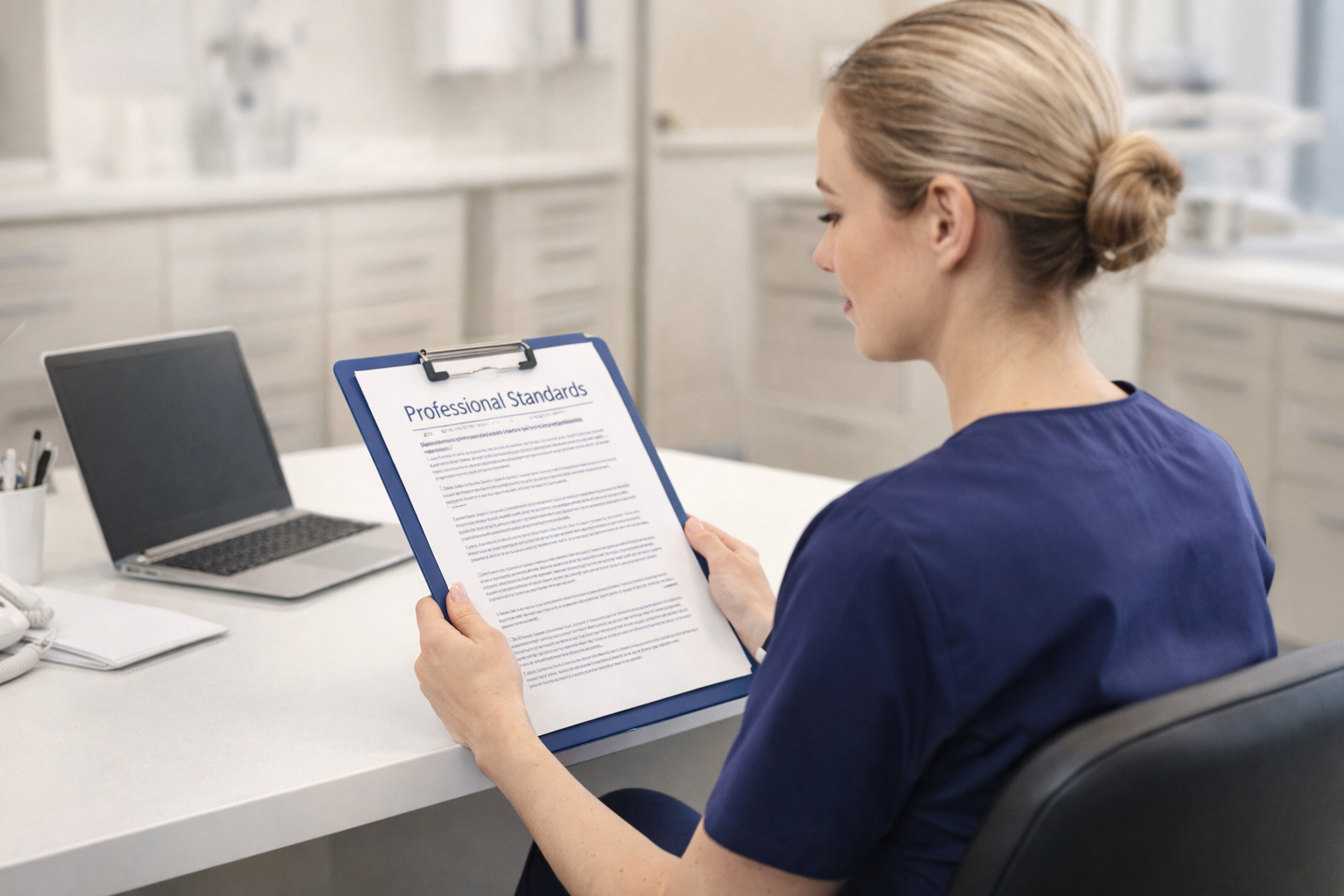
Professionalism is a fundamental part of dental nursing. Every registered dental nurse must understand and follow the professional standards set by the General Dental Council (GDC).
The GDC’s Standards for the Dental Team sets out nine principles covering the professional responsibilities of registered dental professionals, including dental nurses. They address areas such as patient interests, communication, consent, confidentiality, teamwork, raising concerns and professional behaviour.
This guide explains the 9 GDC standards for dental nurses in straightforward language, with practical examples of what they mean in everyday practice. It is designed for both qualified dental nurses and students preparing for the NEBDN examination.
GDC Standards at a Glance
- Nine professional standards for every registered dental professional
- Essential guidance for registered dental nurses and an important professional framework for student dental nurses
- Frequently assessed in the NEBDN examination
- Supports safe, ethical and patient-centred care
- Helps protect your GDC registration and professional reputation
What Is the General Dental Council (GDC)?
The General Dental Council (GDC) is the statutory regulator for dental professionals in the United Kingdom.
Its responsibilities include:
- Maintaining the register of dental professionals
- Setting standards for education, ethics and professional conduct
- Protecting patients and maintaining public confidence
- Investigating concerns about a professional’s fitness to practise
Once you are registered as a dental nurse, you are personally accountable to the GDC. Your professional responsibilities exist independently of your employer’s policies or instructions.
The 9 GDC Standards for Dental Nurses Explained
There are nine GDC principles in the GDC’s Standards for the Dental Team. They apply to all registered dental professionals, including dental nurses, and cover patient interests, communication, consent, confidentiality, complaints, teamwork, professional knowledge and skills, raising concerns, and professional behaviour.
For dental nurses, these principles provide the professional framework for making safe, ethical and patient-centred decisions in everyday practice.
1. Put Patients’ Interests First
Patient welfare should always be your highest priority.
This means:
- Prioritising patient safety
- Acting honestly and with integrity
- Avoiding conflicts of interest
- Raising concerns when patient safety may be compromised
This principle supports many of the concepts covered in our Medical Emergencies Study Guide and Infection Prevention & Control Study Guide.
2. Communicate Effectively with Patients
Good communication builds trust and reduces misunderstandings.
For dental nurses this includes:
- Explaining procedures clearly where appropriate
- Speaking professionally and respectfully
- Reassuring anxious patients appropriately
- Adapting communication to individual patient needs
Communication failures remain one of the most common causes of patient complaints.
3. Obtain Valid Consent
Although dentists usually lead consent discussions, dental nurses must understand the legal principles of consent.
Valid consent must be:
- Given voluntarily
- Based on sufficient information
- Provided by a patient who has capacity
A signed consent form alone does not prove valid consent.
Consent is particularly important during restorative, surgical and sedation procedures. See our Pain & Anxiety Control Study Guide for related clinical examples.
4. Maintain and Protect Patients’ Information
Confidentiality is a professional and legal responsibility.
Dental nurses should:
- Store records securely
- Maintain patient confidentiality
- Comply with GDPR requirements
- Complete accurate clinical records
- Avoid discussing patients in public areas
Accurate documentation protects both patients and the dental team.
5. Have a Clear and Effective Complaints Procedure
Every member of the dental team should understand how complaints are managed.
As a dental nurse you should:
- Know the practice complaints procedure
- Remain calm and professional
- Avoid becoming defensive
- Escalate concerns appropriately
Professional handling of concerns often prevents unnecessary escalation.
6. Work with Colleagues in Patients’ Best Interests
Excellent patient care depends on effective teamwork.
This includes:
- Respectful communication
- Supporting colleagues appropriately
- Challenging unsafe practice professionally
- Following agreed clinical protocols
- Contributing to a positive workplace culture
This links closely with the safe radiographic procedures discussed in the Radiography Study Guide.
7. Maintain, Develop and Work Within Your Professional Knowledge and Skills
Professional development is an ongoing responsibility.
Dental nurses should:
- Complete the CPD required to maintain their registration
- Understand their individual scope of practice
- Maintain and develop their knowledge and skills
- Only carry out tasks they are trained and competent to perform
- Ensure they have appropriate indemnity or insurance for the work they undertake
- Recognise when to refer or seek support if a task is outside their competence
A dental nurse’s scope of practice develops with their education, training and experience. However, you remain professionally responsible for recognising the limits of your competence and working safely within them.
8. Raise Concerns If Patients Are at Risk
GDC Principle 8 requires dental professionals to raise concerns if patients are at risk. Dental nurses have a professional responsibility to act when they become aware of a concern that could affect patient safety.
Concerns may include:
- Safeguarding issues
- Unsafe clinical practice
- Infection prevention and control failures
- A colleague whose health, conduct or performance may put patients at risk
- Serious clinical errors or failures in patient care
Concerns should be raised through the appropriate practice or organisational procedure where possible. However, protecting patients must remain the priority, and concerns should not be ignored simply because they involve a colleague or senior member of the dental team.
Dental nurses should understand their workplace procedures for raising concerns and know when a concern may need to be escalated further.
9. Make Sure Your Personal Behaviour Maintains Patients’ Confidence
Professionalism extends beyond the dental surgery.
This includes:
- Responsible social media use
- Respectful public behaviour
- Professional communication
- Avoiding discriminatory or offensive behaviour
Your professional reputation follows you both inside and outside the workplace.
What the GDC Standards Mean in Everyday Dental Nursing
Professionalism is demonstrated through everyday actions.
Examples include:
- Preparing instruments correctly
- Following infection prevention procedures
- Respecting patient dignity
- Maintaining accurate records
- Working within your competence
- Reporting concerns appropriately
- Avoiding shortcuts
- Supporting colleagues professionally
Professionalism is not simply knowledge—it is consistently demonstrated through your behaviour.
Fitness to Practise: Why It Matters
The GDC may investigate concerns relating to:
- Clinical competence
- Dishonesty
- Criminal convictions
- Professional misconduct
- Health issues affecting patient safety
Possible outcomes include:
- Advice or warnings
- Conditions on practice
- Suspension
- Removal from the GDC register
Consistently following the GDC Standards is one of the best ways to reduce regulatory risk.
Common Misunderstandings
“The dentist is responsible, not me.”
Incorrect. Every registered dental nurse is individually accountable to the GDC.
“If my employer tells me to do something, it must be acceptable.”
Not necessarily. You must always work within your Scope of Practice and professional responsibilities.
“Small documentation errors don’t matter.”
Accurate records are essential. Even minor omissions may become significant if a complaint or legal issue arises.
Why the GDC Standards Matter for the NEBDN Exam
Professionalism is assessed throughout the NEBDN qualification.
You may encounter questions relating to:
- Scenario-based MCQs
- OSCE communication stations
- Consent
- Confidentiality
- Record keeping
- Ethical decision-making
- Scope of Practice
Rather than memorising the standards, focus on understanding how they apply in real clinical situations. This will help you make better decisions during both the examination and your future career.
Why the GDC Standards Matter for Qualified Dental Nurses
Many Fitness to Practise investigations begin with everyday professional issues rather than serious clinical incidents.
Examples include:
- Poor communication
- Inadequate documentation
- Social media misconduct
- Confidentiality breaches
- Working beyond competence
Understanding and applying the GDC Standards helps protect both your patients and your professional registration.
Frequently Asked Questions
What are the GDC Standards for Dental Nurses?
The GDC Standards are nine professional principles that guide the behaviour, ethics and responsibilities of all registered dental professionals in the UK.
Are the GDC Standards included in the NEBDN exam?
Yes. They are commonly assessed through MCQs, OSCE stations and scenario-based questions covering professionalism, consent, confidentiality and ethical practice.
Can a dental nurse be investigated by the GDC?
Yes. Every registered dental nurse is individually accountable to the GDC and may be investigated if concerns arise regarding conduct, competence or health.
What happens if a dental nurse breaches the GDC Standards?
Depending on the seriousness of the concern, outcomes may include advice, conditions on practice, suspension or removal from the GDC register.
How many GDC standards are there?
There are nine principles in the GDC’s Standards for the Dental Team. They cover putting patients’ interests first, communication, consent, confidentiality, complaints, teamwork, professional knowledge and skills, raising concerns, and maintaining public confidence through professional behaviour.
What does GDC Principle 8 mean for dental nurses?
GDC Principle 8 requires dental professionals to raise concerns if patients are at risk. Dental nurses should act when they become aware of concerns that could affect patient safety, such as unsafe clinical practice, safeguarding concerns, infection prevention failures or risks arising from a colleague’s health, conduct or performance.
What are the legal and professional responsibilities of a dental nurse?
Dental nurses are responsible for working safely and within their competence, maintaining confidentiality and accurate records, respecting patient consent, following relevant legal and professional requirements, raising concerns about patient safety, maintaining their professional knowledge and complying with the GDC’s standards.
What is a dental nurse’s scope of practice?
A dental nurse’s scope of practice describes the areas in which they are trained, competent and appropriately indemnified or insured to work. Dental nurses must recognise the limits of their competence and should not carry out tasks they are not appropriately trained and competent to perform.
Continue Your Revision
You may also find these resources helpful:
- Medical Emergencies Study Guide
- Infection Prevention & Control Study Guide
- Radiography Study Guide
- Pain & Anxiety Control Study Guide
- Dental Nurse Mock Exams
- Professionalism OSCE Scenarios
- Dental Nurse Flashcards
Final Professional Perspective
Clinical knowledge alone is not enough to become an excellent dental nurse.
The GDC Standards for Dental Nurses provide the professional framework that underpins safe, ethical and patient-centred care. By applying these nine principles consistently in everyday practice, you strengthen patient trust, protect your professional registration and develop the judgement expected of a competent dental nurse.
Professionalism is not simply another topic to revise—it is the foundation of dental nursing practice.
Discover more from Dental Nurse Hub | Learn, Practice & Grow
Subscribe to get the latest posts sent to your email.