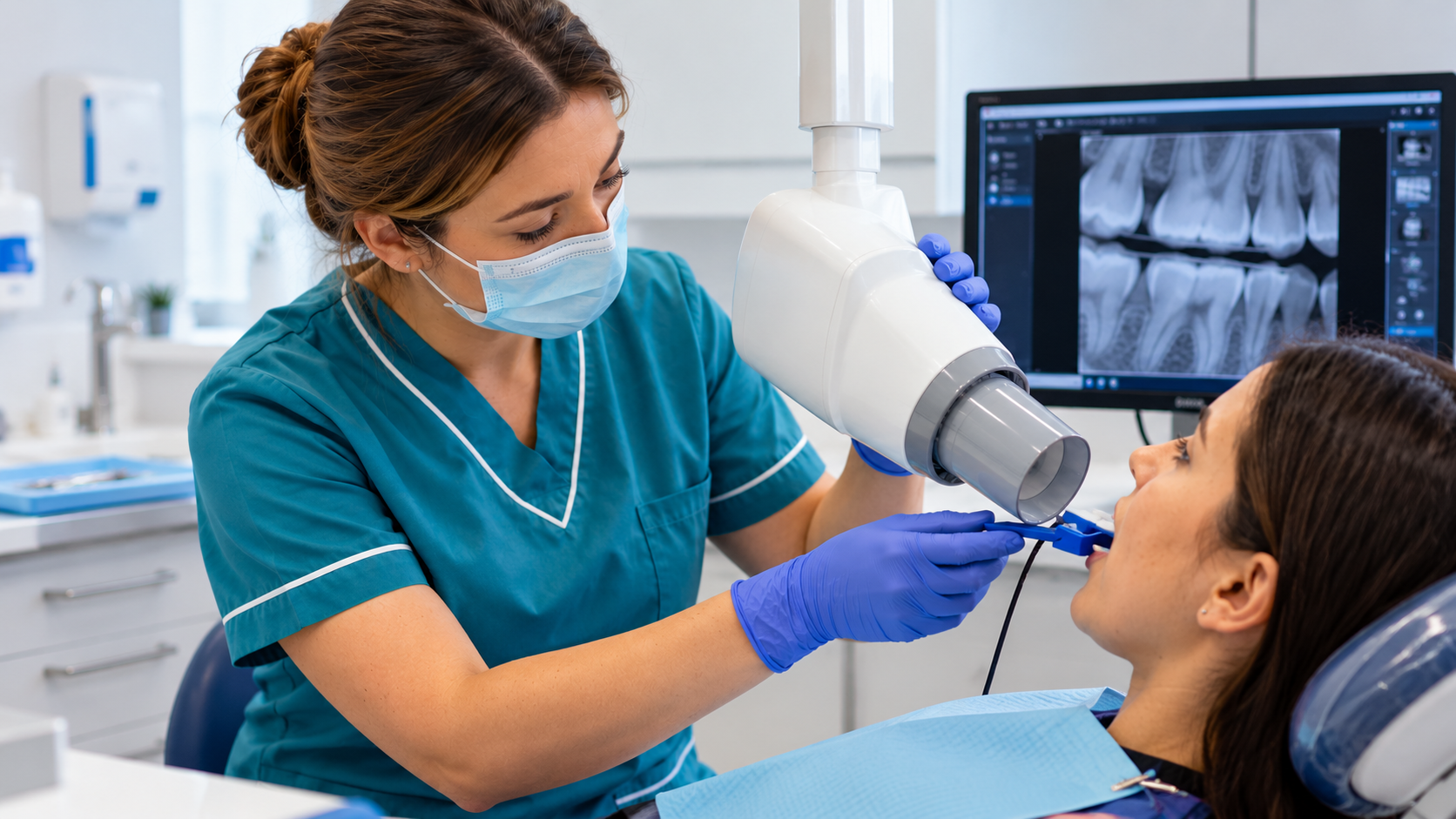
Dental radiography is one of the additional skills qualified dental nurses can develop to become more involved in patient care.
With appropriate training and authorisation, dental nurses can take dental X-rays, support clinical workflows and help ensure radiographs are obtained safely.
But having experience assisting with X-rays is not the same as being qualified to take them.
So, what qualifications do dental nurses need, what can they actually do, and where do their responsibilities begin and end?
Can dental nurses take dental X-rays?
Yes. Registered dental nurses can take dental radiographs once they have completed the required training, demonstrated competence and been appropriately authorised by their employer.
The General Dental Council (GDC) recognises dental radiography as an additional skill within dental nursing.
However, being registered as a dental nurse does not automatically qualify someone to take radiographs.
A dental nurse must have the necessary training, competence and professional indemnity or insurance before undertaking the role.
What qualification does a dental nurse need?
One established route is the NEBDN Certificate in Dental Radiography, a post-registration qualification designed for registered dental nurses.
If you want to refresh your understanding of radiation protection, radiographic techniques and image quality, our Dental Radiography Study Guide provides a useful foundation for further learning.
It prepares dental nurses to take intraoral and extraoral radiographs under prescription, within their authorised scope of practice.
The qualification includes:
Theoretical knowledge of dental radiography and radiation protection.
Practical clinical experience.
A workplace-based Record of Competence.
A written examination assessing knowledge and understanding.
NEBDN currently assesses candidates through a 90-minute examination comprising multiple-choice and extended-matching questions.
Other appropriate recognised training routes may also be available. Dental nurses should confirm that any course meets the requirements for their intended radiography duties.
You can explore the qualification directly through NEBDN Dental Radiography.
What can a radiography-qualified dental nurse do?
Depending on their training, competence and employer entitlement, dental nurses may undertake practical radiography duties such as:
Taking prescribed intraoral radiographs.
Taking extraoral radiographs within their training and authorisation.
Preparing patients and positioning equipment.
Following approved exposure protocols.
Processing and handling digital images.
Participating in radiography quality-assurance procedures where appropriately trained and entitled.
However, taking a radiograph is different from deciding whether the patient needs one or interpreting the findings for diagnosis.
Dental nurses do not independently diagnose disease or plan treatment.
Additional radiography training does not automatically authorise a dental nurse to undertake specialist imaging procedures such as CBCT. Those activities require appropriate task-specific training, competence and entitlement.
Understanding IR(ME)R responsibilities
The Ionising Radiation (Medical Exposure) Regulations 2017, commonly called IR(ME)R, establish responsibilities for protecting patients during medical exposures, including dental X-rays.
Three important roles are:
Referrer: A registered healthcare professional entitled to refer a patient for a radiographic examination.
Practitioner: An appropriately entitled registered healthcare professional responsible for justifying the individual exposure.
Operator: A person entitled to carry out specified practical aspects of the exposure, such as taking the radiograph.
A qualified dental nurse will typically act as an IR(ME)R operator when taking prescribed dental radiographs.
The dentist or another appropriately entitled practitioner remains responsible for justification.
Why employer entitlement matters
Completing a radiography qualification does not automatically mean a dental nurse can begin taking X-rays in any practice.
The employer must formally entitle the individual to undertake specified IR(ME)R duties.
For example, a nurse may be qualified to take intraoral radiographs but not entitled to operate a particular extraoral imaging system.
Qualification, competence and employer entitlement must all be considered before undertaking radiography duties.
Radiation safety: What dental nurses need to remember
Radiography involves ionising radiation, so unnecessary exposure must be avoided.
Dental nurses involved in radiography should understand the following principles.
Only take appropriately authorised radiographs
Radiographs must be clinically justified by an entitled practitioner.
Dental nurses should not independently decide to expose a patient simply because an X-ray might be useful.
Follow approved exposure procedures
Use the correct equipment settings and positioning techniques according to training, local protocols and the examination prescribed.
Good technique reduces avoidable repeat exposures.
Follow radiation protection arrangements
Understand the practice’s local rules, controlled-area arrangements and relevant safety instructions.
The Ionising Radiations Regulations 2017 (IRR17) address occupational radiation protection, while IR(ME)R focuses on the protection of individuals undergoing medical exposures.
Report errors and equipment concerns
Incorrect exposures, equipment faults and suspected radiation incidents should be reported promptly through the appropriate procedures.
Not every error is externally notifiable, but incidents must be assessed according to the applicable requirements.
The CQC provides further information in Dental Mythbuster 3: Dental Radiography and X-rays.
Is dental radiography a worthwhile additional qualification?
For dental nurses interested in developing their clinical skills, radiography can be a valuable professional development opportunity.
It may allow greater involvement in patient care, more varied responsibilities and additional opportunities within general or specialist dental settings.
However, the qualification does not automatically guarantee a higher salary or a different job title.
Its practical value depends on the dental nurse’s interests, the opportunities available in their workplace and how the additional skill will be used.
What should dental nurses remember?
Dental radiography offers qualified dental nurses an opportunity to expand their clinical responsibilities while contributing to safe patient care.
The most important distinction is that holding a radiography qualification does not, by itself, authorise someone to undertake every radiographic procedure.
Dental nurses must remain appropriately trained, competent, indemnified and entitled for the specific tasks they perform.
Frequently Asked Questions
Can a dental nurse take X-rays without a radiography qualification?
A dental nurse cannot independently take radiographs simply because they are GDC-registered. Appropriate training, competence and employer entitlement are required. Specific supervised training arrangements are governed by IR(ME)R and should not be confused with independent practice.
Can a radiography-qualified dental nurse diagnose dental problems?
No. Dental nurses do not independently diagnose disease or plan treatment. Their radiography role is to undertake authorised practical tasks, while appropriately entitled clinicians retain responsibility for justification and clinical interpretation.
Can a dental nurse take CBCT scans?
Potentially, but an ordinary dental radiography qualification does not automatically establish competence or entitlement for CBCT. Additional appropriate training, assessment and employer authorisation are required for the specific tasks undertaken.
This article provides general professional information for UK dental nurses. Always follow current GDC guidance, applicable radiation legislation, employer procedures and the requirements of your individual scope of practice.